
What Do We Lose by Always Trying to Appear Confident? — by Anisoara Laura Mustetiu
Sometimes the path begins exactly where confidence ends
Insecurity has never had a particularly good reputation in my eyes. I spent years trying to conceal it behind a tight smile, a hand that would not tremble when lifting a glass, a voice that would not break halfway through a sentence. I tried to chase it from my eyes, buried it beneath lists of achievements, pressed it down like a wound that needed to close.
I read, practised, and trained myself to become more confident, to doubt myself less, to walk into a room with less hesitation. I worked on learning to trust myself more — to feel clearer about who I was, what I wanted, and where I was going.
At the same time, I have often felt that modern society is not very forgiving of any sign of insecurity. We almost seem to pay a price for every tremor we allow others to see. A tense expression during an interview, a hand that shakes slightly when signing something important, a gaze that avoids overly curious eyes, the blush that rises to your face when you think you have said something wrong — all of these are often treated like errors, flaws that need to be corrected rather than natural expressions of being human.
The moment someone hesitates, loses their confident voice for a second, or allows self-doubt to show, there is a risk that others will see that moment as a crack in their worth. As though a few moments of uncertainty about oneself could erase experience, intelligence, courage, or everything that person has built until then.
I sometimes feel that we have come to value the image of confidence so highly that we end up crucifying the very things that make us human: hesitation, questioning, that small inner tremor that says, I’m not sure… I don’t know.
And perhaps, by fighting our insecurities so fiercely, we only turn their volume up even higher.
But over time, I began to wonder whether I had misunderstood that strange feeling of being unsure of myself. What if it had not come to stop me at all? What if it had simply come to tell me something?
I noticed that whenever an unpleasant feeling appears, my first impulse is to get rid of it. To calm it, explain it, push it away. Much less often have I stopped to ask why it came. What did it notice before I did? What does it know about me? Where is it trying to direct my attention?
Lately, I have begun to see insecurity differently: as a friend.
Not a friend I need to agree with every time or allow to run my life. Just the kind of friend who, from time to time, gently touches my shoulder and says:
Look here. There is something you do not know yet.
When self-doubt appears
I have noticed that self-doubt often appears precisely where something matters deeply to me. A book I want to publish, stepping onto a stage and speaking in public, a road I have never travelled before, a difficult conversation, a change, a possibility.
And here I found it interesting that neuroscience does not necessarily regard states of uncertainty as something we should always avoid. The brain is constantly trying to estimate what it knows and what it does not know, and research suggests that uncertainty can strengthen our capacity to adapt and push us towards new territory, new information, and fresh lessons from life.
But not knowing is not always an empty space that must be filled immediately. It can also be something that sets me in motion. When I do not know, I search, I ask, I learn, I explore.
And then that feeling of being unsure of myself is no longer, for me, only the place where my legs tremble a little. Sometimes it may be the very place from which a new road begins — one I step onto carefully and with curiosity.
But how loudly does it speak?
This is where an important distinction appears for me. I do not believe every kind of self-doubt is beneficial. There is a kind of inner doubt that whispers and one that shouts.
The one that whispers may say:
Pay attention. Look again. Prepare yourself. Ask. There is something here for you to learn.
But when its voice becomes too loud, it can drown out the others: experience, reason, intuition, courage, clarity.
I believe the problem, then, is not the existence of insecurity itself, but the volume at which we allow it to speak.
I do not necessarily want to silence that voice. I want to be able to hear what it is saying without allowing it to fill the entire room.
The ability to return to your own centre, even in the presence of self-doubt, is a true art. It is like trying to stand upright in a boat on a restless sea: your legs tremble, but you know exactly where the bottom of the boat is beneath you and how to shift your centre of gravity until you find your balance again.
Between the fear of not knowing and the freedom to discover
An idea much older than modern psychology comes from the Indian philosopher and author Jiddu Krishnamurti, who said in 1950 that “uncertainty is important in creativity.”
I liked this idea. If I am completely sure of what I know, of who I am, and of what the world should be, what is left for me to search for? What is left to question? What is left to discover?
In another discussion, Krishnamurti described precisely the kind of mind that can say, “I am uncertain,” and then look, search, observe, and ask questions.
Seen in this light, being unsure is no longer the opposite of intelligence. Sometimes, it may even be a continuation of it.
Staying a little while in the unknown
Contemplative traditions, too, have long reflected on this human need for certainty.
In the teachings of the Buddhist nun Pema Chödrön, there is an idea I like: instead of constantly running from discomfort and the unknown, we can learn to remain there for a little while. In those moments of unease, we can learn to relax in the middle of chaos.
She does not tell us to worship insecurity or allow ourselves to be paralysed by it. She simply invites us to learn how to stay beside it.
When the cold shiver of the unknown appears, instead of tightening ourselves and running away, perhaps we can take one deep breath, right there where it hurts. Feel the floor beneath our feet and resist the urge to immediately switch on every light. Sit in the darkness with it for a few moments, until our eyes begin to make out the outlines of things.
The Bhagavad Gita, an ancient Indian text traditionally transmitted and preserved through manuscript culture, offers a simple and profound image: a person can place a seed into the earth, water it, and care for it, but cannot command the sun to make it grow or order the rain to fall.
Perhaps part of our insecurity comes precisely from this simple reality: we cannot receive a guarantee of the outcome before we begin the journey. And still, we go.
The friend I kept trying to send away
Sometimes I wonder whether modern life has increased our lack of confidence in ourselves. We live surrounded by mirrors that constantly show us what we are missing, what we have done wrong, where we have not yet arrived, and what we are supposed to look like.
There is nothing wrong with seeing our mistakes — we need them in order to grow. But what happens when, throughout an entire life, we are shown our mistakes far more often than we are shown what we have done well?
I sometimes think of my grandparents and of that simple sense of security I observed in the people of their world. I do not know whether village life made them more confident. Perhaps they simply had fewer mirrors telling them, every hour, who they should have been.
Today, we carry those mirrors in our pockets.
I am beginning to wonder whether we have spent too much time trying to eliminate something that belongs deeply to the human experience.
What would a person completely free of self-doubt look like? Perhaps not like the ideal human being we imagine. Perhaps a little like a robot: always confident, always calculated, without hesitation, without the vulnerability of questioning, without that deeply human moment when they say:
“I don’t know… I’m afraid…”
I no longer want to ask insecurity to leave. I want to offer it a chair. Not the seat at the head of the table — just a chair. Let it sit there, and when it has something to say, I will listen. It may warn me, show me a wound, tell me that there is still something I need to learn. Or perhaps, sometimes, it simply shows me that I have reached the edge of what I know.
And beyond that edge, something new may begin. I do not think I should become so confident that self-doubt disappears completely.
I only want to become enough of a friend to it that, when it appears, I can say:
I see you… I’m listening… But let’s keep going together.
Anisoara Laura Mustetiu

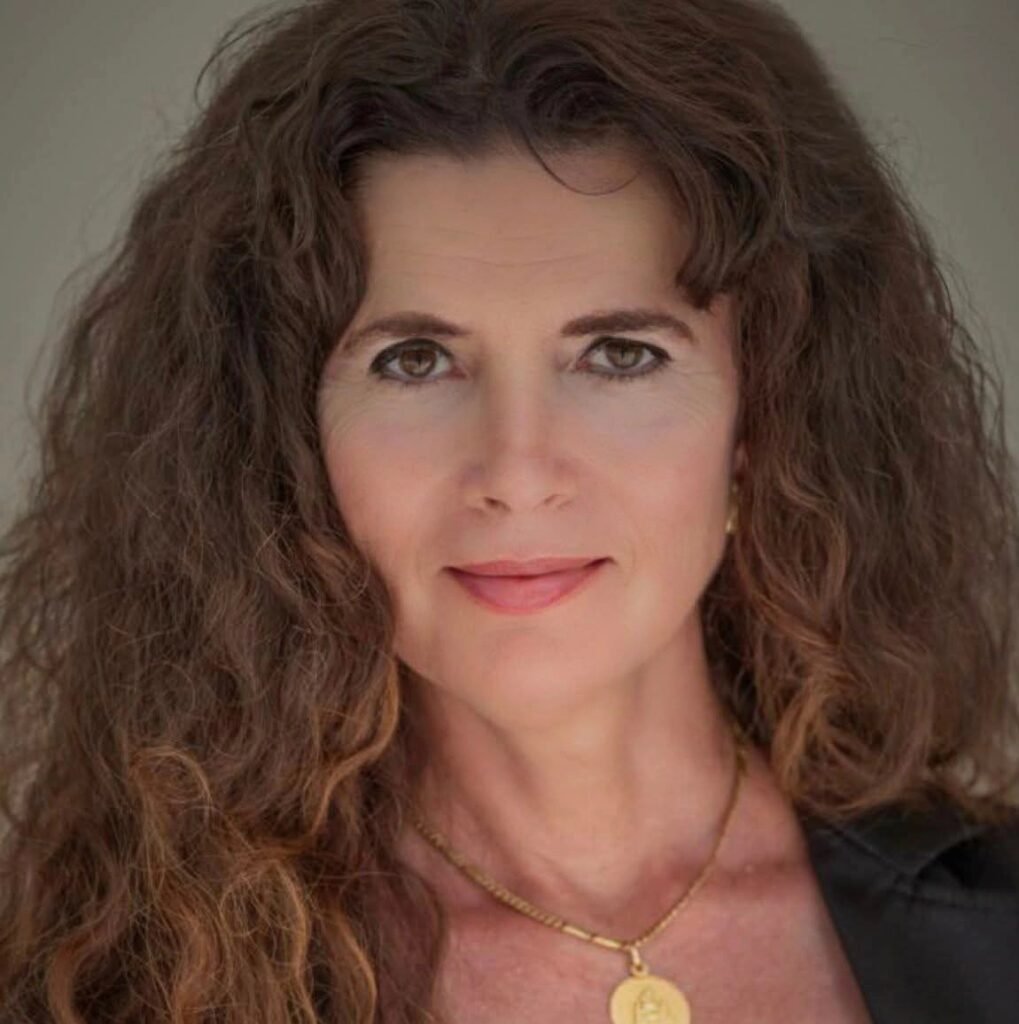
Anișoara Laura Mustețiu is a Romanian writer, born in Timișoara, who spent 24 years in Germany and has been living in Sydney since 2014. She writes prose inspired by real events, love stories, and reflective texts on identity, resilience, personal development, and the meaning of life. With works published in Romanian, English, Italian, and German, she blends literature with insights drawn from psychology, neuroscience, and philosophy.
As a writer, editor‑in‑chief of the magazine Emoții și Lumină, radio editor, founder of the Romanian‑Australian Book Club, and an active on‑stage participant in Romanian‑Australian cultural events for the past decade, she contributes to promoting Romanian literature internationally and strengthening intercultural dialogue. Her books, published in four languages, are available in some of the world’s most prestigious bookstores — including Harvard Book Store, Barnes & Noble, and the royal Hatchards bookstore in London — and can be found in most major international cities.
Photo: by Kieran MacAuliffe, Pixabay